
Services Chiropractic
Pain that keeps coming back has a source. We look for that source.
Chiropractic here is not a random crack. Assessment first, then the right adjustment, so your low back can step out of the flare-up line.

We hear these lines every week.
If one of them is yours, this page is for you.
Locked up again... must be my age.
Age is not a diagnosis. Pain that comes back has a cause, and a cause can be treated.
I've tried everything. It eases, then it comes back.
Pills mute the alarm. They do not fix what sets it off.
My scan showed nothing. It still hurts.
A picture does not show how you move. The assessment does.
I'll wait for it to pass.
Waiting is the plan that puts your life off the longest, and treats the cause the least.
No mystique
So what is chiropractic, anyway?
When a joint does not move well, your body defends itself. The muscles around it lock, other areas take on the extra work, and the pain shows up, often far from where it started.
The chiropractic adjustment gives that joint its movement back. Once it works again, the muscles leave defense mode, the area unlocks, and the pain eases. That is where the relief comes from. And if the cause is never treated, it does not last.
What it is not
chi·ro·prac·tic
noun · from the Greek kheir (hand) + praxis (practice): done with the hands.
What it is for, in practice.
The usual reasons someone ends up on the chiropractic table.
01
Low back and back pain
The best known use: a low back that locks, and pain that keeps coming back.
02
Neck and headache
Tension that climbs out of the neck and lands as a headache by the end of the day.
03
Pain that runs down the leg
Glute, thigh, leg. When the source is the spine, that is where you treat it.
04
More mobility
Turning your head, bending down, reaching. Range of motion, back.
05
Less muscle tension
Muscles that lived on defense finally switch off.
06
Physical performance
A body that moves better trains better, from the beginner to the athlete.
No mystery
What happens in your first session.
You know what will be done, and why, before anything happens. From the first minute to the last.
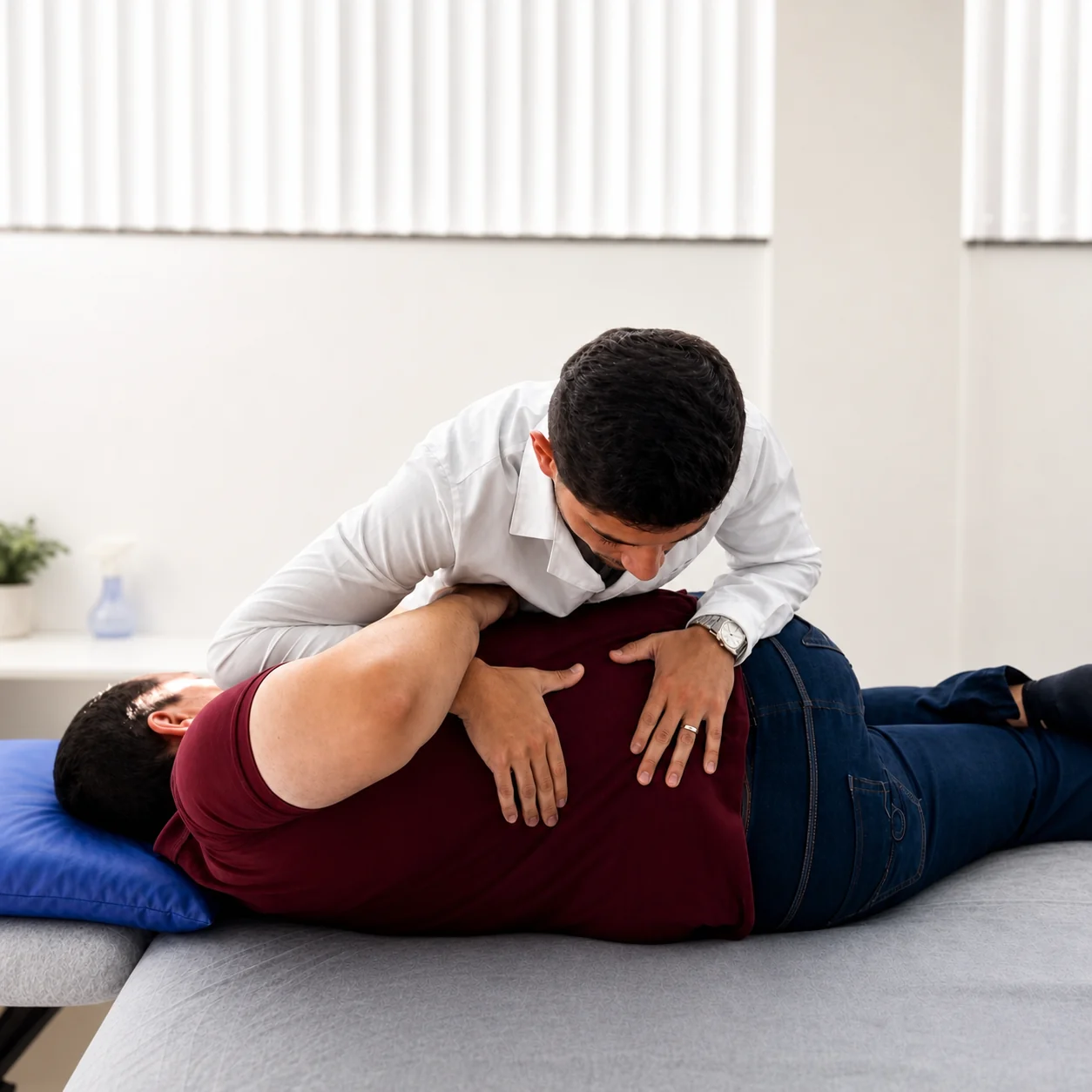
Step 1 · The talk
You tell the story of your pain
Where it hurts, since when, what makes it worse, what you have already tried. That story is worth more than it looks. It points the whole search.
Step 2 · The tests
The assessment looks for the source, not only the spot that hurts
Movement, posture, and spine tests. This is where we decide if your case calls for an adjustment, where to adjust, and, if it does not, you hear that right away.
Step 3 · The adjustment
Fast and precise
A few seconds of movement on the joint the assessment pointed to. The feeling people report most when they get off the table: light, and loose.
Step 4 · Before you leave
You leave knowing the plan, not only relieved
The working hypothesis of the cause, the plan for your case, and what to do at home so the result can last. In the first 24 hours you may feel mild soreness, the kind you get after a workout. It passes.

"Who adjusts your spine matters as much as the adjustment."
Dr. Dyogo Oliveira, a physiotherapist with a specialization in Trauma and Orthopedics and training in Clinical Chiropractic, Manual Therapy, and Dry Needling. More than 10 years in clinic, from the high-performance athlete to your low back. Meet Dr. Dyogo →
Before you ask
"Will everything crack?" What everyone asks on WhatsApp.
How you can tell it is working.
You stop planning the day around the pain.
Sitting, driving, standing in line, without calculating what it will cost you later.
You trust your own body again.
Lifting, training, sleeping on either side, without that fear of "what if it locks."
The flare-ups space out, until they drop off your calendar.
That is the difference between easing one episode and treating the cause. The result holds.
The next flare-up is already booked. Cancel it.
The assessment is the first step. It maps the source, and we take the rest together. No doctor's referral, in downtown Pindamonhangaba.
Book my session on WhatsApp